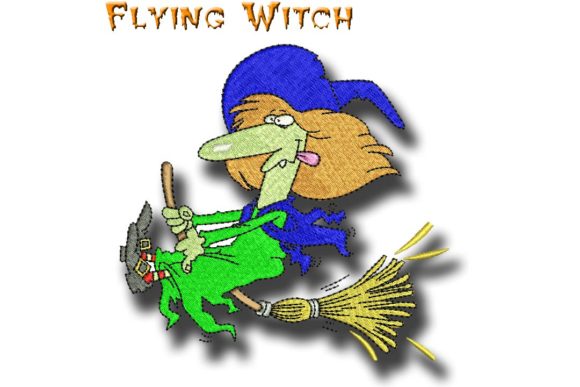
Flying Witch Embroidery Design
The Flying Witch embroidery design offers a unique blend of whimsy and professionalism, making it a compelling choice for small business owners looking to add character to their merchandise. Created by Ron Leishman of Toonaday, this design is ideal for branded patches, custom apparel, and handmade products that aim to stand out while maintaining a cohesive brand identity.
First Impressions: A Design with Personality
Flying Witch immediately conveys a playful yet sophisticated vibe. The illustration balances charm with clarity, ensuring it remains recognizable even when scaled down or used in minimalist applications. This makes it suitable for both bold statement pieces and subtle accents on merchandise.
The design’s visual personality leans toward friendly and creative, which aligns well with small businesses in the arts, crafts, and lifestyle sectors. Its style feels modern enough for contemporary branding but retains a handcrafted appeal that resonates with customers who value authenticity.
Real Business Use: Versatility in Embroidery Applications
Flying Witch excels as an embroidered patch, offering a clean outline that translates well into machine embroidery designs. It works effectively on staff uniforms, aprons, and caps, where visibility and durability are key. The design’s simplicity also allows for easy customization of thread colors, making it adaptable to different brand palettes.
For tote bag designs and work shirts, Flying Witch adds a touch of individuality without overwhelming the overall look. It can be used as a chest logo accent or as a sleeve detail, depending on the desired effect. Small business merch like event giveaways and customer gifts benefit from its eye-catching nature, helping to reinforce brand recognition.
As a digital embroidery file, Flying Witch is likely compatible with common hoop sizes, including 5x7, which is standard for many embroidery machines. This makes it accessible for both hobbyists and professional embroidery shops looking to offer custom apparel services.
Where to Use with Caution
While Flying Witch is versatile, there are certain applications where it may require careful consideration. On small patch sizes, the intricate details could become lost, so it’s important to test the design at reduced scales before final production. Similarly, curved surfaces like cap fronts may challenge the design’s proportions, requiring adjustments to ensure a balanced appearance.
High stitch density or detailed outlines might cause issues on textured fabrics or dark uniforms, where the contrast between the design and background could be less effective. For such cases, using a stabilizer and testing on real fabric is crucial to achieving a polished finished product.
Impact on Brand Identity and Customer Perception
Flying Witch contributes to a brand’s visual consistency by adding a memorable element to merchandise. When used across multiple products—such as aprons, tote bags, and packaging accents—it helps build a cohesive brand image that customers can easily recognize.
The design also enhances the perceived value of handmade products and custom apparel. Its artistic quality suggests craftsmanship and attention to detail, which can increase buyer engagement and trust. For small businesses, this is especially valuable when competing in crowded markets where differentiation is key.
Practical Tips for Embroidery Designers
Before finalizing any project, it’s wise to test the Flying Witch embroidery design in black and white to assess how it appears without color. This step can reveal potential issues with contrast or detail that may not be obvious in color.
Check if the design works at smaller patch sizes, as this will determine its suitability for items like employee badges or product labels. Reviewing the thread color contrast ensures that the design stands out on various fabric types, from light cotton to dark denim.
Inspect the spacing between elements to avoid overcrowding, especially when using the design on curved surfaces. Confirming the hoop size and stabilizer requirements is essential for achieving a smooth, professional finish. Creating a printable mockup for client approval can help manage expectations and reduce revisions.
Conclusion: A Design That Works for Many
Flying Witch is a strong contender for small business merch, custom apparel, and branded patches. Its balance of creativity and clarity makes it suitable for a wide range of applications, from casual wear to professional uniforms. With proper testing and adaptation, it can elevate a brand’s visual presence while maintaining a handmade aesthetic that appeals to discerning customers.
For embroidery shops and craft businesses, this design offers both artistic flexibility and commercial viability. As long as the specific requirements of the project are met—such as hoop size, fabric type, and thread color selection—it can serve as a valuable addition to any embroidery file collection.
Ultimately, Flying Witch demonstrates the power of a well-crafted design to enhance brand identity, improve customer engagement, and support the growth of small businesses through thoughtful, high-quality embroidery solutions.